Welcome to Moving Smart!

Helping parents and teachers understand the LEARNING benefits of all those wiggles & giggles!

Showing posts with label ece. Show all posts

STICK-TO-ITIVE-NESS

WHY CAN'T KIDS FINISH WHAT THEY START?

Have you ever noticed some kids jump from one activity to another without spending concentrated time on any one thing or just never seeming to finish anything? Adults may see this as a sign the child can’t stay focused, gets bored easily, or gives up without the resilience to keep trying. 

But for little ones, it may simply be a matter of physical endurance. For instance, drawing a picture takes concentrated hand strength. When their hand gets tired, it doesn’t feel good. So they switch to another activity that uses a different set of muscles giving their hand a chance to rest.


It’s actually a clever strategy if you think about it. But learning to finish what you start is an important readiness skill (and mind-set) for school and life.


GET OUTSIDE & PLAY

If you've noticed this tendency, watch to see if they’re using different muscle groups when they jump from one activity to another. If they are, consider introducing more time outdoors and on the playground. All whole-body active play will naturally build up stamina and endurance across all the muscle groups which, over time, will give them the power they need to stick with it!


For more information on movement & learning, follow us on Facebook and Instagram.  https://www.facebook.com/MovingSmartNow

KIDS THAT GO BUMP


We’re guessing every parent knows this kid. The one who goes bump into everything... the furniture... the potted plant... the ever-patient pet... and especially you. They’ll practically knock you over if you’re not looking! 


We call those “bump ‘n hugs” and in our view, they’re the best part of the day. 


But did you ever wonder why they do it?


WHY KIDS GO BUMP

The technical term for it is proprioception - our internal GPS system. You see, children aren’t born with an understanding of their own bodies. They don’t even know their own size or shape at first. They learn it over time through interactions with the people, places, spaces, and things in their path.


But it’s not as simple as introducing your child to the ottoman and they’re good to go. Their body is always growing which means their spatial relationships are constantly changing. And that’s why they go bump. As we describe it in A Moving Child is a Learning Child...


“It’s not a question adults have to think about. But it’s a big idea for little ones. Will I fit? And that likely explains why kids love to climb in, on, around, under, over, and through things. It’s their way of exploring their place in our world.


HOW YOU CAN HELP

Sit back and watch and you’ll see your child is working on this all the time. Notice how they might take an indirect route to get where they’re going, preferring to go under the coffee table for example, or over the arm of a chair.


Consider what you have right in your own living room they could navigate. For instance, throw pillows on the floor that challenge them to move over or around them. Put different sized cardboard boxes around so they can see how they fit into them. Use the dining room set as a natural tunneling system. Position the ottoman to block their path so they have to retrace their steps. (But don't be surprised if they decide it's a mountain to climb!) Or choose a row of tiles on the floor or a crack in the sidewalk to walk along. 


Encourage them to move in space-related ways. For instance, bring your head down when crawling under things. Move sideways in tight spaces. Bend your knees to jump over things. 


And most important of all, the next time you get a bump ‘n hug, be sure to hug back extra tight so they know you are where they always fit.


MR. POTATO HEAD'S LAUNDRY DAY

OK. Nobody likes laundry. But even laundry can be a fun, learning activity for preschoolers while you're knocking a big chore off your list. So here's what you do...

HOW TO PLAY...


As you're folding the laundry, choose articles of clothing from the basket and encourage your child to identify each item (e.g., socks, shirts, pants, underwear, etc.). Talk about how we wear the different items. We wear socks on our feet. We wear shirts on our backs, etc. This establishes the concept of "order" for your child. 

Now, like Mr. Potato Head, let's mix it up and play with the concept of "disorder." Only in this game, your child is Mr. Potato Head!

Start by wondering out loud what it would be like to wear your socks on your ears. Coax your child to try wearing her socks on her ears. And put socks on your own ears too. Oh, how silly! And the fun has begun.


Your child may take it from there, but if not, suggest a few other mix ups to give her the idea. For instance, I wonder what it would be like to wear your pants on your arms? Or your underwear as socks? Or see what it's like if you climb into dad's shirt together! In other words, the sillier the better!


WHAT THEY'RE LEARNING...
What we just described is a game involving patterns, sequences, order and disorder, all essential underpinnings to problem solving, creativity, and mathematics. That might sound a bit heady or academic, but in fact, children are naturally introduced to these concepts through everyday, physical experiences and play.

For instance, early on babies adapt to daily routines which give them a sense of security and belonging through the predictable order of life. Toddlers eventually figure out that it's better to put the big block on the bottom in order to support the smaller blocks on top. With enough repetition, preschoolers they learn that "A" comes before "B." And of course, we all inevitably arrive at the conclusion that socks come before shoes.


Further, dressing the "wrong" way actually instills a sense of pride and confidence that they're "in the know." They know the right way to dress!

And in the process, you might even get the laundry done.


Stay home. Stay well. Have fun. And keep moving!


P.S. When we asked friends and family to snap some photos of this game for us, even the older kids wanted to join in and had fun with it!


PLAY MAKES THE BEST TEACHER

We wrote a blog post called Parents Make the Best Playmates several years ago and it has always been one of our most popular topics. (You'll see the post in full below.) In these days when parents are being called upon to guide their children's learning at home, it's important to understand in the early years, play is the most powerful learning tool of all.


We'll dig deeper into the power of play over the next few weeks, but for now, rest assured. You don't need a degree in education. All you need to do is relax and play. Because even if you don't recognize it in the moment, your child is learning in so many ways...

Play is TANGIBLE and PHYSICAL. Kids are tangible, physical creatures. That's why they can't sit still.

Play is a WHOLE-CHILD EXPERIENCE, inviting the body, senses, emotions, imagination, and natural problem solving to the party. That's why she becomes so engrossed she doesn't even hear you calling to her.

PLAY BEGINS WITH THE CHILD, making the entire experience personal and relevant. That's why she puts on her tiara and goes out to the garden to make mud pies. It makes sense to her.

Play is how children learn to RELATE TO OTHERS. That's why it's important to make time for the two of you to play together each day.

Which brings us to today's topic. As important as play is, we've found some parents don't fully understand their role in the process. Take a look at our original blog post for a few ways you can become a better playmate to your child and have fun along the way...


PARENTS MAKE THE BEST PLAYMATES
All child development experts (including me) will tell you that one of the best things you can do for your child is to play with your child. But those same experts (including me) often lament that parents don’t always know HOW to play with their kids.

I have a theory about this. Adults sometimes struggle with “child’s play” because it is counter-intuitive to what’s expected of us in every other part of our lives. As adults, we’re expected to be strong, mature and in control at all times; responsible, efficient, effective, and results-oriented. Yet it is these exact qualities that make adults INEFFECTIVE as play partners to their children.  

To help you understand what I mean, here are a few rules of thumb I prescribe for parents during playtime...


FOLLOW, DON’T LEAD. When it comes to play, your child is better at it than you are.  Know your place and follow her lead (unless safety becomes an issue).

GET SHORTER. Whenever you can, bring yourself down to her level (both physically and emotionally). This is your time to see the world through her eyes.

KEEP IT POINTLESS. True play has no agenda – no rightness or wrongness to it. Whatever happens happens. Keeping playtime open and free is not only the best way to encourage your child's imagination, it's also the best way to help her learn naturally.

And no matter what, remember, playtime is for both of you, so relax and go for the ride!


THE OVER-UNDER JOURNEY!     
Playing collaborative games equalizes the playing field for your child while giving you a perfect, kids-eye-view of life!  Next time you have a few minutes, try taking an Over-Under Journey and you might just be amazed where the two of you end up!

SET UP
1. Start by deciding where to go.  You may want to go to a real place like the kitchen or you could think of grander, imaginative places like the Dinosaur Forest or the Princess Castle!  (Wherever you decide to go, pick a physical location 10-15 feet away as your target for a game of 5-6 turns.)  Let your child decide the destination and then follow her imaginative lead.

2. Next, decide who is "Over" and who is "Under."  Again, let your child decide.  

3. Using only your bodies and your imaginations, the "Over" player must travel each step of the journey by going over the other player.  Likewise, the  "Under" player must go under the other player.

GAME PLAY
Here’s a few ideas to get you started.  Note:  These ideas are written for parents but can easily be adjusted for children as well.  But be sure to let your children make up their own over/under obstacles as much as possible.
  • Go OVER THE HILL (stand tall and let your child climb all the way up you!)
  • Go UNDER THE BRIDGE (form a bridge with your body or legs and let your child climb under)
  • Go OVER THE TICKLE TIGER (lie down on your back and have your child climb over your tummy -- tickling as she goes!)
  • GO UNDER GATE (lie on the floor and raise one leg in the air up and down.  Have your child scoot through the gate.)
  • Go OVER THE TEA POT (sit on the floor and form the shape of a tea pot.  As your child climbs over you, whistle like a tea pot!
  • Go UNDER THE PUDDLE (lie down on the floor tummy-side down.  Have your child "swim" underneath you)
  • GO OVER THE WORM (wiggle like a worm on the floor and have your child climb over you from head to toe)
  • GO UNDER THE TUNNEL.  (sit on the floor with your knees up and have your child climb through)

Have fun, and let me know how your journey went!

A KINETIC CHRISTMAS: Tinsel Toes


Day 19
Tinsel Toes
FROM LEAPING TO SKIPPING (4+)

Click to Enlarge
SANTA'S TAKE-OFF
On Christmas Eve, while every one's busy in the Workshop getting Santa ready to take off, there's one elf outside getting the take-off ready.

His name is Tinsel Toes and he's in charge of the tinsel that lines the runway. It's a really long runway, and every flutter of tinsel has to be perfectly straight so the sleigh sets off in the right direction!

Now, this is a big job, but don't you worry. Tinsel Toes has been doing it for as long as anyone can remember. He's bound to get it right one of these years.

(OK. So if you really want to know the truth, the runway is always crooked as a candy cane. But don't blame Tinsel Toes. It's not his fault. It's the tinsel! You see, it's a little known fact that when you step on tinsel, it tickles your toes and makes you dance! And when you dance, it's hard to keep things straight!)

Maybe you'll have better luck. Would you like to help Tinsel Toes lay out Santa's runway? But just beware. Your toes might start dancing!


TINSEL TOES
Back on Day 1 of our Kinetic Christmas series, we talked about the sensory value of tinsel. So let's take that a step further…. do these games BAREFOOT...

TINSEL BEAM. Lay out a single path of tinsel and walk on it all the way to the end. Now, walk backwards on the tinsel back to where you started. (Remember to try to keep your runway straight!)

TINSEL RUNWAY. Lay out two strands of tinsel parallel to each other about 6" apart. Step carefully BETWEEN the tinsel. If your toes touch the tinsel, stop, lay down, put your feet in the air and twinkle your toes!

TINSEL TWIZZLE. Lay out two strands of tinsel parallel to each other about 12" apart. Cross-walk along the tinsel, putting your right foot on the left tinsel, your left foot on the right tinsel. (Some children may need assistance with this. It's an advanced midline activity, so stand by just in case.)

TINSEL TROUBLE. How many ways can you dance on the tinsel? For instance, try walking the length of the tinsel on your tippy toes... your heels... the sides of your feet. How would a caterpillar dance on tinsel? A monkey? A penguin?

DO THE TINSEL TIZZY! Put on some upbeat music and dance, but here's the trick. All throughout the dance, you must have at least one foot on the tinsel! (It may help to pretend to "glue" his foot to the tinsel. Rub his foot with your hand, then "stick it" to the tinsel. This gives him a physical cue to remember to keep his foot still.) Make up some dance steps for your child to try, then have him make up his own. And don't forget to Do the Tinsel Tizzy with him! After all, toes are for dancing!


Wishing you a happy, healthy, and active holiday season!


THE KINETIC SCALE: Beyond Gross & Fine Motor


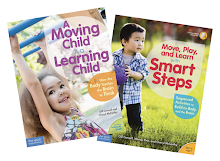
Well, it's official! A Moving Child Is a Learning Child is in print!

Here's a little preview


In our new book, you'll see we're introducing a brand new tool we haven't talked about yet here on the blog. We call it THE KINETIC SCALE, going beyond gross and fine motor to better understand how movement fuels the body and the brain for learning. (Oh, and health and fitness too!)


I like to think of The Kinetic Scale as the food pyramid for movement. Ibreaks movement down into its essential "nutrients," making it easy to see and understand what's happening in children's development. And of course, once you know what goes into it, it's easy (and fun!) to create a "well balanced diet" of movement kids need each day.


We'll talk more about The Kinetic Scale and how to use it in the coming weeks. But in the meantime, once again, Cheryl and I would like to thank all of you for your inspiration, support, and encouragement in bringing A Moving Child Is A Learning Child to life.

(And by the way, the next time someone asks you to sound serious on a playground full of kids, tell them that's a seriously silly idea!)


Image from A Moving Child Is a Learning Child: How the Body Teaches the Brain to Think by Gill Connell and Cheryl McCarthy, copyright © 2013. Used with permission of Free Spirit Publishing Inc., Minneapolis, MN; 800-735-7323; www.freespirit.com <http://www.freespirit.com> . All rights reserved.