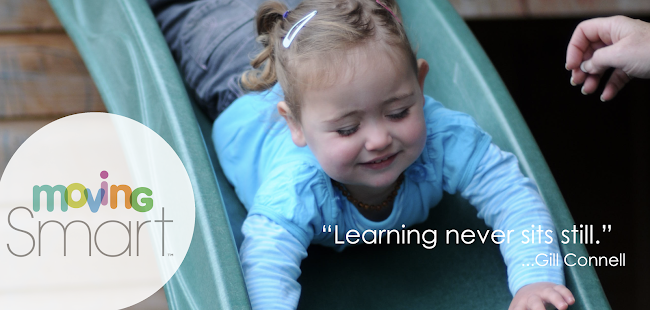


A child's hand is a powerful tool for learning. With his hands he can control the world around him, build and create all that he can imagine, and express himself, first in gestures, then with scribbles, and eventually with the written word.
Parents know the importance of fine motor control -- especially when it comes to handwriting -- which is probably why I'm frequently asked for advice on this subject. Here's what I say...
Put your pencils down and go play on the monkeybars.

NATURAL ORDER OF THINGS
Parents know the importance of fine motor control -- especially when it comes to handwriting -- which is probably why I'm frequently asked for advice on this subject. Here's what I say...
Put your pencils down and go play on the monkeybars.
NATURAL ORDER OF THINGS
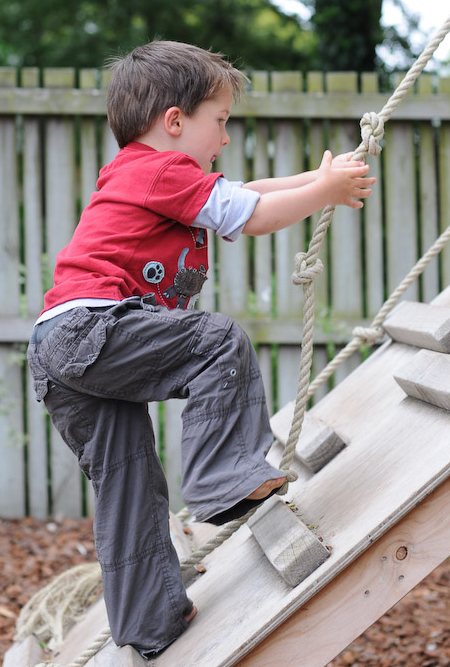
Children's muscle control and coordination is developed in a natural, orderly way -- from the top down and from the inside out -- starting at the head and working towards the toes while building out from the torso to the limbs. This order of priority, established by the brain, insures that the large muscles necessary for coordination and locomotion (getting from here to there) are well organized and in control, before taking on the complex mastery of the more than 60 combined muscles in the hands (let alone the dozens of bones, hundreds of ligaments and tendons, etc., etc.)
So you see, on the developmental totem pole, the hands come last.
WHAT IS FINE MOTOR DEVELOPMENT?
Now, that doesn't mean that your child's hands aren't active as he's growing. Young hands begin with simple, reflexive, whole-hand grasping. Over time, early reflexes integrate and the pincer grip kicks in, allowing him to use his forefinger and thumb together in unison. Each day, you'll see more and more deliberate hand and finger movements. But that's not fine motor skill -- not yet.

So you see, on the developmental totem pole, the hands come last.
WHAT IS FINE MOTOR DEVELOPMENT?
Now, that doesn't mean that your child's hands aren't active as he's growing. Young hands begin with simple, reflexive, whole-hand grasping. Over time, early reflexes integrate and the pincer grip kicks in, allowing him to use his forefinger and thumb together in unison. Each day, you'll see more and more deliberate hand and finger movements. But that's not fine motor skill -- not yet.

Fine Motor Skills are the highly precise motor control necessary to bring all five fingers together to do detailed work requiring minute, almost imperceptible movements, such as using a pencil to write your name.
But writing your name isn't all in the wrist, so to speak. In fact, it involves much of whole body.
IN ORDER TO WRITE MY NAME
But writing your name isn't all in the wrist, so to speak. In fact, it involves much of whole body.
IN ORDER TO WRITE MY NAME
1. The upper body must be strong enough to hold the body in an upright standing or sitting position.
2. The shoulders muscles must be strong enough to control the weight of the arm, and flexible enough to rotate freely to position the arm for writing.
3. The upper arm holds the weight of the lower arm and hand, delivering the hand to the page.
4. The lower arm provides a sturdy fulcrum on which the wrist rotates.
5. The wrist holds the hand steady and rotates to the appropriate position.
6. The fingers fold around the pencil which is held in place by the thumb.
7. Together, all five fingers do a precision dance on the page: a. placing the pencil at the exact angle to meet the page, b. pressing down and maintaining the right amount of pressure to leave the imprint, and c. coordinating the tiny up, down, left, and right movements across the page.
If any of those
muscles in that chain of events don't do their job, writing his name will be a
very hard thing to do.
Which brings us
full circle back to the monkeybars...

PLAYING "WRITE"
Climbing,
hanging, swinging, and any other high-energy activities that build strength in his upper body and core
muscles are vital precursors to fine motor skills.
Twisting,
turning, dangling, and swinging helps develop the flexibility and agility necessary for rotating the shoulders, elbows, wrists, and fingers.
Pushing, pulling,
tugging, and lifting himself up builds strength while developing an intuitive understanding of simple physics such as weight,
pressure, and resistance.
And when he comes
off the monkeybars, messy play is ideal for building up strength and dexterity in the hand muscles. Play-Doh, sand and
water play, mud (yes, mud!), and any other tactile play is great sensory
experience for the brain and hands which one day may mean neater handwriting!
So remember. When
it comes to getting ready for writing, "M" is for Monkeybars!

Sometimes, it's just not possible to make it over to the playground for a turn on the monkeybars, so here are a couple of my favorites you can do at home to build upper body and core strength while the hands "wait their turn" in the developmental chain of events.

Wheelbarrowing around the playroom or out in the backyard is great for building up arm strength (in between the giggling, of course.) Importantly, I recommend holding your child at the hips rather than by the feet. This prevents an unnatural bow in the back, while lightening the load on those little arms.

CRAB WALKING
Kids love this and you'll be amazed how far they can go with a little practice. Sit on the floor and raise up your seat using your hands and feet. Then crab - crab - crab along as far as you can go. Have kids go forwards and backwards too!
 CATERPILLAR WALKING
See how slow you can go, inching along like a caterpillar! Walk your hands out in front of you, then walk your feet up to your hands.

See how slow you can go, inching along like a caterpillar! Walk your hands out in front of you, then walk your feet up to your hands.




 Posts
Posts


Great post - love the ways to build on the upper body, but mostly love that body strength needs to come first.
ReplyDeleteJamie
This is a great post. Do you have this in another form? Or would you mind if I copied it (and give you full credit) I think this would be so good for the parents of my toddler/preschool kiddos that I care for.
ReplyDeleteJen S
Thanks so much! Yes, I think we can all get too wrapped up in seeing progressing with handwriting, forgetting there are so many other elements that go into it besides learning our letters.
ReplyDeleteJen, we can provide the post for you as a PDF if that suit your needs? What are the ages of the kids you look after?
Great post. With writing being taught at such a young age many teachers and parents lose sight of what needs to come first. Occupational and physical therapists are always explaining this. Thanks for the well written explanation.
ReplyDeleteThis is a great post, just wondering if you have any references? From the language this comes from occupational therapy but wanted to see about specific resources for our school resource list. Thanks for posting them!
ReplyDeleteThank you for this fantastic post! Love the clear connection between small and large motor. Your ideas to explore and strengthen our muscles/motor are wonderful! Thanks again.
ReplyDeleteLove it! Physical development promotes more than just running, jumping, grasping and reaching! We should encourage ECE practitioners and parents to look at the 'bigger picture'. Awesome post!
ReplyDeleteGreat article! My son recently started receiving OT, due to weakened muscles in the shoulder/ chest. He was having trouble gripping a pencil and using scissors. Prior to my sons difficulties, I never realized the connection between these muscle groups. Great article and great resource for parents.
ReplyDeletelove this - just tweeted. You gave so much information! Also good for #spd kiddos.
ReplyDeleteThis is a great post for parents and preschool teachers!
ReplyDeleteWow you always have great information for typical kids but so insightful too me when I think about my girl with serious motor control issues. I love it. I shared your blog with my daughters physiotherapist here in canada she studied in South Africa and spent time in New Zealand and had taught a course in your methods years ago . She is the best therapist too. She is the reason my daughter is walking her and CME therapy.
ReplyDeleteSherry - So glad you find the blog useful. If there are any other topics you'd like us to write about, please let us know. And I'm so glad to hear CME therapy is working so well for your little one!
ReplyDeleteThis is a fabulous post, it is like music to my early childhood trained ears! Off to promote it on Twitter and FB :)
ReplyDeleteThanks, Christie! So glad we've connected. Much appreciated! Keep in touch...
ReplyDeleteHi Gill
ReplyDeleteI really love the monkey bars and have seen how beneficial they are to the children's learning. The children 'get it' they feel that they are getting stronger and really take on the challenge of getting from one end to the other and they love to celebrate their success! I just wish the parents would 'get it too'. I keep on keeping on and passing on all your wonderful information.
I too would love to have this as a PDF so that I can pass it on to our families.
Thanks again you are an inspiration!
Excellent post!
ReplyDeleteLove the post. We talk to parents a lot about gross motor development and how it relates to all other areas. Love how you explained it on your blog.
ReplyDeleteI would love this as a pdf, too.. I teach ECE to high school students and we run a Pre-K in our classroom. This information is so important and fundamental to how children learn. Thanks!
ReplyDeleteFab, thanks for this. And one for me to remember the next time mine are monkeying around climbing the stairs using the bannisters!
ReplyDeleteHow do you explain why my 5 year old has always had excellent fine motor but no upper body strength. She is just about the only one in her class who can't do the monkey bars, she can't do a crab shape, or a handstand and she can only manage the wheelbarrow for a few seconds (she is almost 6!). I despair of her! but she has always been excellent at drawing and writing, using scissors, fastening buttons etc
ReplyDeleteOf course, there are so many different variables with each child, it's difficult to pinpoint why she is developing in this way. One possible explanation is what we call "splinter skills" -- when a child likes doing something so much, such as art and writing, she focuses on that and ignores other types of play. This doesn't mean that her upper body strength won't develop, it's just not quite there yet.
ReplyDeleteThe trick in these situations is to make the skill you want to encourage more fun. If wheelbarrow races and crab walking aren't for her, try easier variations to help her build her confidence and ability. For instance, if you hold her at her waist during a wheelbarrow game, there will be less weight on her arms which will make it easier and more fun for her. Likewise, there's no rule that says you can't crab walk with your seat on the ground until she builds up her strength. Also, you may want to "disguise" upper body activity inside of other games. Rough 'n tumble roughhousing is great for pushing and pulling and learning about her own strength. Group games like tug of war will require her to use her upper body strength, and because she's not alone will take any pressure off of her if she's feeling insecure. And consider introducing gardening. The simple act of digging in the dirt, carrying pots, plants, watering cans, etc., are all great muscle conditioning activities.
Please keep us posted on her progress and let us know if you have any other questions. Thanks!
Brilliant post, thanks for sharing! Linked back in this week's Outdoor Play linky! Would love for you to come share some of your thoughts there any time!
ReplyDeleteGreat posts!! Just reposted this to my blog!! Really enjoyed it! Would love for you to follow me @ www.toddlerbedandmore.blogspot.com!
ReplyDeleteThat's pretty cool!
ReplyDeleteWhat an amazing post! I think that a lot of parents forget (or don't know) how important gross motor play is for later fine motor development. I'm going to pin and share this post everywhere! Thank you!
ReplyDeleteWonderful post! Could I get this in PDF format too?
ReplyDeleteJust incredible. As a teacher and a parent this article is a wonderful resource.
ReplyDeleteI know this was posted a while ago, but if you're still checking posts, I'm a teacher who would love this in PDF as well. Thank you!
ReplyDeleteI love this post. It is so appropriate for my little boy who struggles with his fine and gross motor skills. I think the parents on my course would be interested in the information and I would want to give you the credit...please can I have a pdf copy too?!
ReplyDeleteThank you very much for the excellent article. I have a 2 years and 9 months old son and he loves wheelbarrowing. Crab walking and caterpillar walking sounds fun too!!
ReplyDeleteWOW!!! Love this article and am so glad I found it!!! Is there any way I can get a PDF version to share with my colleagues and administrators?
ReplyDeleteThank you!
kcahcrim@comcast.net
Hi,
ReplyDeleteThis post explains this process so well! Could I also have a pdf version so I can hand it out to parents and post on my website? Thanks, Barbie
bgallini@comcast.net
I love this. I am working on a potential workshop to be presented to other nannies and possibly to others who are part of caring for children birth to age 8, may I use some of your points as reference please.
ReplyDeleteAmen!!!!
ReplyDeleteAre there any studies that support this?
ReplyDeleteI can't help but feel this is a big load of crap. I was one of those kids that loved hanging off the monkey bars. My friends and I would challenge each other to stay on the longest which could last entire recesses. All those pictures above of children doing exercises, i also enjoyed doing. However, my hand writing was atrocious and still is to some degree. I don't believe that by hanging from the monkey bars will improve your hand writing, but I do agree it is an important tool in helping it get better. Now, working on my masters in architecture, I have learned that it is only by practicing to draw the letters, not write them that will improve your hand writing.
ReplyDeleteYou are correct that monkey bars will not directly improve handwriting but these core activities do prepare the body to be doing fine motor precision activities with less fatigue and more control.
DeleteTo be a good hadnwriter you need to have a specific motor plan for each letter that is explicitly taught and practised. When parents or daycare teachers insist on print before the hand is ready for precision control, an inefficent grasp is encouraged. But print or cursive itself needs motor plans; often this is left to chance or to the child himself to figure out. Classrooms spend less and less time on teaching this skill, thinking it is not as important as literacy. The two go together. When a letter is written a different way each time or with various start points, the result is often messy looking and does not have "fluidity". As well, the child masters different forms at different ages, eg. diagonal lines are difficult up until specific age;if letters with diagonals are learned before this age, they will be perceived and practiced as vertical lines instead of as diagonals. Letters that cross midline , like T will be difficult also. There is an optimal time for everything.
If you are "drawing" the letters, it should be with the corect motor plan, doing it slowly until mastered and then working for speed. I work with students teaching handwriting/printing skills.
I also would love a PDF for this to jintaar@yahoo.com please. Playing 'I am a fish I have no legs' in swimming pools would likely be in this category as well :)
ReplyDeleteFor Anonymous: I suspect that you had the gross motor skills development subset in developing writing skills but yes, writing as drawing letters can also help a lot. It is a different subset. The young girl mentioned above with weak upper body strength likely had that subset without the gross motor one. One skill set has SO many subskills, and each helps.
I am 37 years old and I have terrible penmanship. I try very hard to form the letters properly, but it always looks terrible. I can type 70 WPM as a result. I am going to try some caterpillar walking to see if that improves things. :) Great article...my poor handwriting has always been a mystery to me. I think I have some clues now.
ReplyDeleteSuch music to my ears! and the rest of my body. I am in the business of providing on the field fitness training to young athletes who play high caliber sports - teens, mostly. Ironically, 2 things I often use are the "wheelbarrow" and the "crab walk." Kids of all ages still learn by moving. And core strength does allow the soccer finesse to come out and play. Thanks for the excellent post.
ReplyDeleteA wonderful post. Please don't stop there. Put these ideas in a separate list and keep adding to it. Maybe you could even accept submissions. I often need a spur of the moment activity, and it would be great to have a regular place to turn to. thanks again for a great post.
ReplyDeleteHi. I would also like it as a PDF. I teach little kids overseas and parents would love this
ReplyDeletessharp1774@yahoo.com
thanks
What a wonderful informative post. It was a refreshing read, I think sometimes parents and early years workers put to much emphasis on being able to hold a pencil and write their name.
ReplyDeleteLove it :-)
Mummy G talks parenting xxx