Welcome to Moving Smart!

Helping parents and teachers understand the LEARNING benefits of all those wiggles & giggles!

Showing posts with label a moving child is a learning child. Show all posts

KIDS THAT GO BUMP


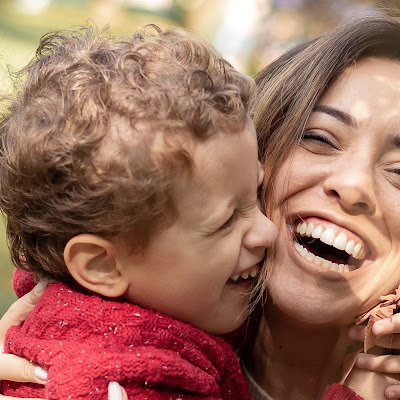
We’re guessing every parent knows this kid. The one who goes bump into everything... the furniture... the potted plant... the ever-patient pet... and especially you. They’ll practically knock you over if you’re not looking! 


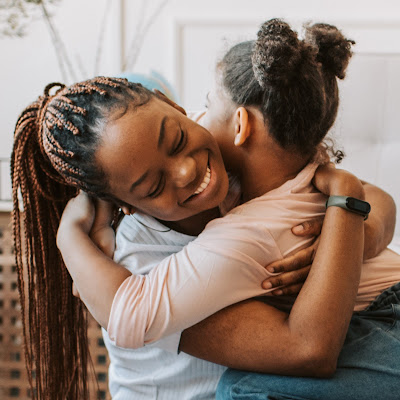
We call those “bump ‘n hugs” and in our view, they’re the best part of the day. 


But did you ever wonder why they do it?


WHY KIDS GO BUMP

The technical term for it is proprioception - our internal GPS system. You see, children aren’t born with an understanding of their own bodies. They don’t even know their own size or shape at first. They learn it over time through interactions with the people, places, spaces, and things in their path.


But it’s not as simple as introducing your child to the ottoman and they’re good to go. Their body is always growing which means their spatial relationships are constantly changing. And that’s why they go bump. As we describe it in A Moving Child is a Learning Child...


“It’s not a question adults have to think about. But it’s a big idea for little ones. Will I fit? And that likely explains why kids love to climb in, on, around, under, over, and through things. It’s their way of exploring their place in our world.”


HOW YOU CAN HELP

Sit back and watch and you’ll see your child is working on this all the time. Notice how they might take an indirect route to get where they’re going, preferring to go under the coffee table for example, or over the arm of a chair.
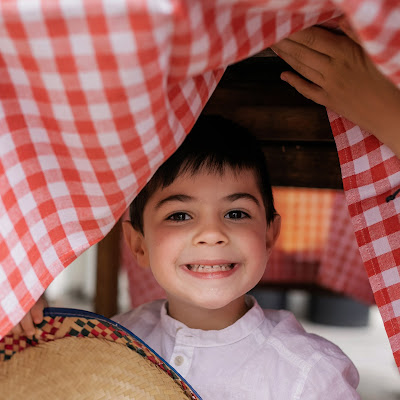

Consider what you have right in your own living room they could navigate. For instance, throw pillows on the floor that challenge them to move over or around them. Put different sized cardboard boxes around so they can see how they fit into them. Use the dining room set as a natural tunneling system. Position the ottoman to block their path so they have to retrace their steps. (But don't be surprised if they decide it's a mountain to climb!) Or choose a row of tiles on the floor or a crack in the sidewalk to walk along. 


Encourage them to move in space-related ways. For instance, bring your head down when crawling under things. Move sideways in tight spaces. Bend your knees to jump over things. 


And most important of all, the next time you get a bump ‘n hug, be sure to hug back extra tight so they know you are where they always fit.


A KINETIC CHRISTMAS: Tinsel Toes


Day 19
Tinsel Toes
FROM LEAPING TO SKIPPING (4+)

Click to Enlarge
SANTA'S TAKE-OFF
On Christmas Eve, while every one's busy in the Workshop getting Santa ready to take off, there's one elf outside getting the take-off ready.

His name is Tinsel Toes and he's in charge of the tinsel that lines the runway. It's a really long runway, and every flutter of tinsel has to be perfectly straight so the sleigh sets off in the right direction!

Now, this is a big job, but don't you worry. Tinsel Toes has been doing it for as long as anyone can remember. He's bound to get it right one of these years.

(OK. So if you really want to know the truth, the runway is always crooked as a candy cane. But don't blame Tinsel Toes. It's not his fault. It's the tinsel! You see, it's a little known fact that when you step on tinsel, it tickles your toes and makes you dance! And when you dance, it's hard to keep things straight!)

Maybe you'll have better luck. Would you like to help Tinsel Toes lay out Santa's runway? But just beware. Your toes might start dancing!


TINSEL TOES
Back on Day 1 of our Kinetic Christmas series, we talked about the sensory value of tinsel. So let's take that a step further…. do these games BAREFOOT...

TINSEL BEAM. Lay out a single path of tinsel and walk on it all the way to the end. Now, walk backwards on the tinsel back to where you started. (Remember to try to keep your runway straight!)

TINSEL RUNWAY. Lay out two strands of tinsel parallel to each other about 6" apart. Step carefully BETWEEN the tinsel. If your toes touch the tinsel, stop, lay down, put your feet in the air and twinkle your toes!

TINSEL TWIZZLE. Lay out two strands of tinsel parallel to each other about 12" apart. Cross-walk along the tinsel, putting your right foot on the left tinsel, your left foot on the right tinsel. (Some children may need assistance with this. It's an advanced midline activity, so stand by just in case.)

TINSEL TROUBLE. How many ways can you dance on the tinsel? For instance, try walking the length of the tinsel on your tippy toes... your heels... the sides of your feet. How would a caterpillar dance on tinsel? A monkey? A penguin?

DO THE TINSEL TIZZY! Put on some upbeat music and dance, but here's the trick. All throughout the dance, you must have at least one foot on the tinsel! (It may help to pretend to "glue" his foot to the tinsel. Rub his foot with your hand, then "stick it" to the tinsel. This gives him a physical cue to remember to keep his foot still.) Make up some dance steps for your child to try, then have him make up his own. And don't forget to Do the Tinsel Tizzy with him! After all, toes are for dancing!


Wishing you a happy, healthy, and active holiday season!


A MOVING CHILD IS A LEARNING CHILD


When my writing partner, Cheryl McCarthy and I sat down to talk about writing my second book, her first question to me was "why do you want to write this book?"

I explained that I believe movement is the under-appreciated piece of the early childhood puzzle, and that I wanted parents and teachers to understand the vital role movement plays in helping little ones reach their fullest potential.

I sat back, fully satisfied with my answer and thought, job done. Writing this book is going to be a snap.

Cheryl paused, leaned forward and rephrased the question. "No. I meant, why do you WANT to write this book? What's in it for YOU?"

Wow.

I was stumped. My mind raced. Tears welled. I leaned forward for the words and managed a whisper. "I wish I knew then what I know now."

There it was. My 30 year quest to uncover what makes kids tick was actually a personal journey to understand myself through the lens of the two most important roles of my life -- parent and teacher.


Knowing what I know now, I really was ready to write this book. And I was (and still am) humbled by the thought.

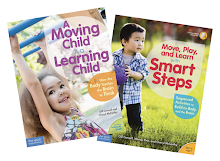
With gratitude to our families and friends for all of their support over the past three years, and the amazing team at Free Spirit Publishing for their guidance and partnership, Cheryl and I are so pleased to share with you the first excerpt from A Moving Child Is a Learning Child.

And so it begins...


Opening Passage from...
A Moving Child Is a Learning Child

All learning begins with the body. It has to. Itʼs our point of reference—our own personal, portable True North, so to speak. And for children, itʼs even more because the body is the brainʼs first teacher.

And the lesson plan is movement.

From grasping your finger to grasping her rattle to grasping the mechanics of crawling, standing, walking, jumping, and those hurtling-headlong-hugs, every move a young child makes—intentional or accidental—leads to learning. Movement develops her physical capabilities, of course. But at the same time, it is building sensory perceptions and critical pathways in the brain necessary to reach her full potential.


It's been well reported that within the first years of childhood, approximately 90 percent of the neural pathways in the brain will be set for life. Those pathways determine how a child thinks and learns, but more, they will shape who she becomes . . . her passions and pursuits, triumphs and challenges, inner reflections, outer reactions, and outlook on life . . . all flowing through the neural network built by her earliest physical and sensory experiences.


With breathtaking simplicity, nature has created this move-to-learn process to be both dynamic and self-perpetuating, building the body and brain simultaneously. As such, the more a child moves, the more she stimulates her brain. The more the brain is stimulated, the more movement is required to go get more stimulation. In this way, nature gently coaxes the child to explore beyond her current boundaries towards her own curiosity to acquire new capabilities. And that, of course, is what we call learning.


Adapted from A Moving Child Is a Learning Child: How the Body Teaches the Brain to Think by Gill Connell and Cheryl McCarthy, copyright © 2013. Used with permission of Free Spirit Publishing Inc., Minneapolis, MN; 800-735-7323; www.freespirit.com. All rights reserved.

Thank you to all our readers for your continued support for our work, and your love, care, and advocacy for children everywhere.

A Moving Child Is a Learning Child will be available now! 


BAREFOOTIN'

In a world seemingly obsessed with carefulness these days, one of the things I fear is getting lost is the joy of going barefoot, and along with it all the benefits. For little ones, getting and staying in touch with their feet is important. Here's why...


Five Great Reasons to Go Barefoot!

1. BODY MAPPING. Babies aren't born with a sense of their own body, and in fact, don't even realize they have hands and feet for a while. The way they find out is through feeling them, tasting them, and putting them to good (and mischievous!) use. Little ones who have their feet stuffed into footed onesies, slippers, socks, and/or shoes, all day and night run the risk of never truly getting to know their toes.

2. STRENGTH. Feet have a big job everyday holding our weight. Wearing shoes and socks provides support but also takes some of the responsibility off of the muscles in the feet. Going barefoot is the most natural way to keep feet in tip-top shape!

3. ADAPTABILITY. When I was a kid, I couldn't wait for summer to run barefoot outdoors (as every kid did out in the country where we lived). But those first days were always a little hard on the feet. Softened up by the padding of socks, shoes, and indoor carpeting all winter, our feet had to toughen up. It hurt a little, but it was so worth it!  Not only does going barefoot give kids a great sense of personal freedom, it teaches them a fundamental principle of independence -- how to adapt to different situations -- even the rocky ones. (Of course, city kids have it different I realize, so find a park if you can. And remember, going barefoot around the house has many of the same benefits.)

4. CONFIDENCE. When children feel their steps directly, they are much better able to understand the intricacies of even the trickiest terrain and navigate it more adeptly. This is true for flat surfaces as well as inclines. Indeed, shoes tend to slip when children climb on playground equipment, while feet are naturally designed to provide sensitive traction, and toes flex to give us better grip.

5. CONNECTEDNESS. Feet are our connection to the earth. They are where we meet gravity. Which makes me wonder. Could our modern image of ourselves be upside down? What would the world be like if we believed we begin in our feet and end in our minds?


In gratitude to Mum and Dad for all those well-grounded, barefooted, gone fishin' summers.

Take my word for it. Go to ITunes and download the 1966 hit song Barefootin' by Robert Taylor. Then throw off those socks and shoes and show everybody what dancin' feet can do!

BAREFOOTIN'
By Robert Parker
Nola Records, 1966

Everybody get on your feet.
You make me nervous when you in your seat,
Take off your shoes and pat your feet,
We're doin a dance that can't be beat! 


We're barefootin', We're barefootin', 


We're barefootin', We're barefootin', 


Went to a party the other night, 


Long Tall Sally was out of sight 


Threw way her wig, and her high sneakers too, 


She was doin a dance without any shoes 


She was barefootin', She was barefootin', 


She was barefootin', She was barefootin', 


Hey little gal with the red dress on, 


I bet you can barefoot all night long 


Take off your shoes and throw them away, 


Come back and get them another day 


We're barefootin', We're barefootin', 


We're barefootin', We're barefootin', 


Lil John Henry he said to Sue, 


If I was barefootin' would you barefoot too 


Sue told John, "I'm thirty two, 


I was barefootin ever since I was two 


They was barefootin', they was barefootin' 


They was barefootin'', we barefootin' 


We barefootin' we barefootin' 


We barefootin' we barefootin' 


We barefootin' we barefootin' 


We don't have no shoes on