Movement is at the very core of how children develop intellectually, emotionally, socially, and of course, physically. Here at Moving Smart we foster children's naturally move-to-learn style while helping parents and teachers understand the comprehensive benefits of all that wiggling!

That's why we say "A Moving Child is a Learning Child."

So let's get moving!

Tuesday, May 28, 2013

"ACADEMIC CREEP"


Not long ago, I was talking to a mom of a three year old little girl. She was clearly a loving mom and very in tune with her daughter who was bright, curious, fun-loving, happy, and healthy. In other words, all's well.

But this mom was concerned that her daughter "wasn't interested in anything educational in nature." She explained that she's tried lots of different ways to interest her child in letters and numbers, but her daughter "just isn't having any of it." So she wanted to know if I had any tried and true ways of introducing the ABCs and 123s to little ones.

I think this concern is very concerning.


What Is Educational?
In our current culture, it seems we've all embraced the notion that anything related to academics is "educational" and everything else is somehow not. I call this "academic creep" -- a teach-to-the-test mentality that's clouding our view of learning and short-changing our children by denying one simple, intuitive truth...

For kids, EVERYTHING IS EDUCATIONAL.

Forgive my soap-boxedness about this, but honestly, how could we have come so far in advancing human knowledge only to have narrowed the definition of "educational" to academic subject matter?

I'll never forget the first time my daughter Becky waved bye-bye on her own. I was so proud, I told everyone how smart she was. And she was! She heard "bye bye" and knew what to do. That's what I call learning.

Education vs. Academics
And what we call things actually does matter because words shape our attitudes and actions. Certainly, learning letters and numbers is educational. But so is learning to wave "bye bye," and how to put on your socks, when to say please, what it takes to get to the top of the monkeybars, and how not to get caught with your hand in the cookie jar.

A child who understands everyday language is ready for school.

A child who dresses herself is ready for school.

A child with good manners is ready for school.

A child with stamina, coordination, and persistence is ready for school.

A child who understands there are rules she is expected to follow and consequences when she doesn't is ready for school.

It's all educational. It's just not academic.

And we must learn to separate the two in the way we think and speak about learning.

What is Kindergarten Readiness, Really?
Now, you might be asking yourself, what about all those stories of kids not being ready for kindergarten? As an educator and professional development consultant, I agree many kids are NOT as ready as they need to be today. As I see it, there are two academic trends colliding here: 1. we're expecting more from kids earlier, and 2. we're starting them earlier.

I realize this sounds like double-talk, but it's the adult logic that's backwards here, in my view. It makes sense to us that if a child needs more preparation for the higher standards we set, we should start them earlier. After all, practice works, doesn't it? But learning at these early ages is a function of developmental and neurological maturity. The brain simply isn't wired up enough to process information the way it needs to be processed for schoolwork. And sitting little ones around a table doing worksheets is the exact OPPOSITE of what they need to be "ready" for learning at that higher level.

Early childhood learning is a personal, follow-your-nose journey of play and exploration with no other agenda than what's fun and fascinating right now. That's nature's educational plan. In fact, a three year old's brain is far more receptive to learning from mudpies and monkeybars than ABCs and 123s right now.

Of course, gently introducing them to new things they haven't found on their own is a great way to expand their learning horizons. But expecting them to engage or "perform" academically or in any other arena, is another matter entirely. They'll do their best to oblige us, of course, but if they can't, all we're doing is setting the table for unnecessary stress and frustration.

Attitudes Towards Education
Just because a preschooler isn't showing interest in letters and numbers yet does not mean she's not interested in "anything educational in nature." That's an adult concept of what education is supposed to look like being applied to three-year-old behavior set against the backdrop of "academic creep."

So when that mom applied the "educational" label to letters and numbers, without realizing it, she was actually ignoring the educational value in everything else her child WAS interested in doing.

But what worries me most is the possibility of a false or fear-laden judgment forming about the child's attitude towards academics, while overlooking her individual disposition for learning. After all, how’s a three year old supposed to know the difference between what's “educational” and “not educational?” And even if she could, would she really be savvy enough to strike an attitude about it, good or bad?

We need to respect and celebrate learning in all its forms at all stages of early development. And yes, sometimes that may be academic in nature. But if it's not right now, that's perfectly OK. It will happen when she's ready.

In the meantime, mudpies and monkeybars still have plenty to teach.


Thursday, May 16, 2013

SINGSTRUCTIONS


As a mum and former early years teacher, I am fully qualified to tell you it can be really difficult to get little ones to follow instructions sometimes. Now, sure, there are times they don't want to do what you're asking of them. And of course, they're easily distracted (especially when they don't want to do what you're asking of them!). But in my experience, when instructions are a struggle, it probably has more to do with the brain's ability to process new information and store it in memory long enough for the instruction to be carried out.

It may not seem like it, but children are born with the same memory capacity adults have. What they're lacking is the experience they need to use it efficiently or effectively just yet. That's because in the early years, the brain is laying down neural pathways that determine how information is processed, stored, and retrieved. Until those pathways are in place, reliable memory (short-, working-, and long-term memory) is still a work in progress.

There are lots of fun ways to help children manage memory tasks, but one of my favorites is music...

Music & Memory
Music works together with the brain to compress information and make it easier to retain. You see, the human brain has limits to what it can store in short-term memory at any one time. The repetitive nature of a musical melody enables the brain to group or "chunk" multiple pieces of information. 

An obvious example is The ABC Song. Long before a child grasps the complex concept of symbolic language, he's able to sing all the letters of the alphabet -- in order! We think "how smart!" But it's really music condensing 26 pieces of information into one memory.

Singstructions
So it goes, that if music helps little ones remember, then you both stand a better chance with instructions if you add music to the mix. So here's an easy trick... sing your instructions. 

That's right, SING them.

For instance, try singing the following lyrics to the tune of Old MacDonald Had a Farm...

Time to tidy up today
Let's put our toys away.

Time to go. We're on our way!
Hooray! Hooray! Hooray!

Come sit by me and have a chat.
Come circle round the mat.

Music also cuts through the audio clutter to get children's attention...

Show me how you listen here.
Give me both your ears.

 And, once the kids are familiar with your Singstructions, pause to let them finish the lyric. For instance, try a musical reminder of good manners and have the children sing "please" and "thank you" with you...

To be polite you must say PLEASE
And THANK YOU very much


Dancestructions
Of course, little ones will remember even more when they physicalize the instruction. So add movement through dance, finger plays, or whatever else works. For example, rub your hands together as you sing...

Scrub-a-dub-dub
Let's wash our hands
And don't forget the SOAP!


Setting a Collaborative Tone
More than a memory trick, music and movement can be a shared language that makes you partners in the instruction. Striking a collaborative tone fosters understanding and respect between you while giving kids an active role in the decision making. And any time a child plays a part in deciding things for himself, he's learning what it feels like to be self-reliant.


So when it’s time to get the job done, start singing! And if you're shy about your voice, don't worry. Kids respond to the voices they know, love, and respect (even if you do sound like a frog!).

Close your eyes and snuggle in.
And let your dreams begin.

Wednesday, March 20, 2013

WHAT CARDBOARD BOXES CAN TEACH KIDS


Like red rubber balls and teddy bears, broccoli refusals, skipping rope, sticky fingers, boo boo kisses, bath time pouts, and nighty night tuck ins, I think cardboard boxes are essential kit for little kids.

And the granddaddy of them all are refrigerator boxes.

Guess what arrived at my house the other day? (he-he-he!)

After a day with my grandchildren and a big cardboard box, it got me thinking about why kids love cardboard boxes, and why cardboard boxes are great for kids...

Six Learning Dimensions of a Cardboard Box
(Refrigerator or Otherwise)


1. SPATIAL AWARENESS. Babies do it. Toddlers do it. Preschoolers too. (And I bet more than once you've secretly wanted to as well.) The first thing little kids do when confronted with a cardboard box is try to get in it. Cute as this is, there's actually an important reason why they do this. It's called Spatial Awareness.

You see, in the early years, little ones spend a good deal of time getting to know their own bodies, and with that comes the necessary question "how big am I?" But they're growing, so the answer to that question keeps changing. That's why kids are constantly testing their own size by crawling in, through, around, over and under things. And cardboard boxes are often the perfect size for this kind of spatial exploration.

2. COMFORT & SECURITY. There's also an emotional component to seeking out small spaces. Right from the start, children are soothed by a sense of being bundled up or embraced in mommy's arms. This need for "denning" continues throughout childhood (and I would argue throughout life) because in many ways, it's a subconscious return to the comfort of the womb.

3. EMPOWERMENT. Imagine what it's like to always be the smallest person in a room. Everything is sized for big people. In small spaces, kids feel BIG. (Sometimes it's good to be small.)

Likewise, the light-weight construction of a cardboard box enables young children to move and manipulate an object that is bigger than they are. In other words, cardboard yields to their will.

4. CONTROL. Cardboard boxes make ideal hiding places. And kids love to hide. Now, I haven't made a scientific study of this, but I believe the hiding game may well be the first experience a child has with knowing something you don't know. And I think this is such a powerful idea when we grow up, as adults we intuitively "get it."

Think about it. The hiding game usually begins with an impish grin as she ducks out of sight. Without even thinking about it, you join the game. "Hmmm. I wonder where Caitlin is? I can't see her. Is she under the pillow? No. Is she behind the couch? No. Hmmm. Is she on my head? No..."

Then comes the big surprise! "Here I am!" And of course, the tone in her voice let's you know she's got one up on you. What fun! And what a powerful role reversal that is!

5. ASENSORY PLAY.  I've read a lot and I've written a lot about the importance of providing children with rich sensory experiences each and every day. Yet "asensory" experiences play an important role in sensory development as well.

For instance, the humble cardboard box is a great example of an asensory environment. The brown color suggests nothing in particular. The smooth sides infer little. The cube structure defines empty space. The subtle smell lacks distraction. The sound of the cardboard folding is muted and music-less. This very LACK of sensory inputs (or perhaps, more accurately said, the subtle nature of the sensory inputs) is an essential contrast to the more powerful and deliberate stimulation we traditionally think of when we talk about "sensory play."

This relief from the sensory world may explain, in part, why kids find the confines of a cardboard box so appealing. And of course, its very neutrality is the blank-slate upon which children so easily imprint their imaginations...

6. IMAGINATION. Much as been written about this, but for my money, the minimalist Not A Box, by Antoinette Portis says all that needs to be said on the subject.


Introducing A Big Cardboard Box
For the record, turning a box into a plaything is an eco-friendly first lesson is waste-not, want-not. So when you have the opportunity, try encouraging preschoolers to think about the concept of reusing things for other purposes. For instance, you might explain the purpose of packaging -- that the box was designed to protect the product so that it wouldn't get scratched. But that doesn't mean that's the only thing you can do with a box. Then wonder aloud... "I wonder what we could do with this big box? What do you think?"

Children's natural curiosity should take over, but if the size of the thing is a bit overwhelming, you might want to encourage a few ideas to get her started, and before you know it, you won't be able to get her out of it!


Big Box Ideas?
If you've got a great big cardboard box idea you've tried with your kids, I'd love to hear about it! Please post your link here in the comments section. Thanks so much.

Enjoy!


For this post, we focused on oversized boxes, but any size box can be put to re-use for recycled fun. Here are a few activities I found on Pinterest I think would be great to try. Thanks to all the "pinners" for sharing!

Red Ted Art's Blog
One Box: 40 Crafty Ideas

The Imagination Tree
Small World Play: Cardboard Box Town
http://pinterest.com/pin/148618856425690093/

Boy Germs
25 Ideas for a Carboard Box

Pink & Green Mama
Cardboard Box Play House, May 2012
http://pinterest.com/pin/148618856425689981/

Molly Moo Little Tales & Tips
Cardboard Aquarium

Tot Treasures
Glow Stick Fun

Bolig Liv
Cardboard Display Shelf
http://pinterest.com/pin/148618856425690066/


If you enjoyed this post, you might also like...

Why Hopscotch Matters

Tuesday, January 1, 2013

HAPPY ENDINGS


New Year is a time for happy endings and bright beginnings. And this year we have more than our fair share of both!

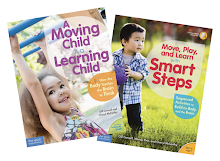
Behind the scenes throughout 2012, my writing partner Cheryl McCarthy and I have been busy putting the finishing touches on my second book. Today, I'm so pleased to announce we will be working in partnership with Free Spirit Publishing to release A Moving Child is a Learning Child in Fall, 2013!

A Moving Child is a Learning Child will launch in the United States and New Zealand to begin with, then hopefully out to other markets around the world soon thereafter.

As we all know, learning never sits still, so we have two simple goals for A Moving Child is a Learning Child. First, we will be presenting an exciting new approach to early childhood movement for optimal, whole-child development (that's the "Moving" part). Then we'll be examining the inextricable role movement plays in early childhood learning (that's the "Learning" part), while providing lots of practical guidance and proven, easy, and fun move-to-learn ideas for teachers, parents, and caregivers.

Indeed, this is a very happy ending to a very busy year, and a bright start to a whole new chapter for Moving Smart in 2013! We'll tell you more about the project as we go along this year, but for now, let's celebrate this very happy ending with a long overdue blog post!

Happy New Year, everyone!


HAPPY ENDINGS

The other day, my granddaughter had a sleepover and we were playing together for most of the afternoon. I had to jump on a quick conference call so I stepped away for a few minutes, leaving her happily playing princess in the living room.

When I came back out, I asked her what had happened while I was gone. But she didn't answer me. I asked again. Still no answer.

And then I realized she wasn't in my living room any more. In that short time she had transported herself to a world she created all for herself... a world called play.

DEEP IN PLAY. DEEP IN LEARNING.
There are essential bodies of research on the subject of play. (If you want to read more on the topic, I've listed a few of my favorites below.) But in a nutshell, the research adds up to one simple, organic, and time-honored truth. Play is the most important thing a child can do to expand her mind, body, and sense of self because play gets the body up and moving and the imagination out and exploring.

When a child enters into a deep state of play, she's in charge of what's real and what's important. Time stands still as she makes her own discoveries and draws her own conclusions about things. And in those powerful moments of creation and decision-making she is laying down the foundations for all future learning by figuring out for herself how she learns best.

It's no wonder my little four year old wasn't hearing a word I said. For children deep in play, the reality of our world melts away in favor of their own, far more vibrant, and yes, REAL, reality. And anything that tries to intrude on that (like nosy grannies) gets filtered out.


PLAY INTERRUPTUS
In my view, we should strive to respect play as an essential part of growing up by giving children opportunities to enter into deep play as much as possible and for as long as possible. That said, time does not always stand still for grown-ups, and sometimes it's necessary to interrupt or stop the play. But if you've ever spent time with playful little ones, you know that can create a fuss. And of course, the more deeply they're engrossed in what they're doing, the bigger the fuss.

Now, I'll admit I've never made a scientific study of it, but over the years, I have found some strategies work better than others. So, in the hope of helping you navigate the tantrum-filled waters of "It's time to stop," I thought I'd share some of my favorite ways to create happy endings...

Distraction
Strictly speaking, I find this strategy bit of a cheat and I'm always left feeling a bit guilty about it, but it does work most of the time.

Have something you know your child likes at the ready like a favorite book or toy. Or create your own transitional ritual. For instance, I keep a magic wand in the closet. We call it Magic-Magic Wand. When I sense we need to change things up, I bring out the wand and we cast our own magic spell. And sure enough, Magic-Magic always has a new, fun idea for us to play!

GRANNY & CAITLIN CAST A SPELL...
Magic-Magic Wand so true.
What's the next fun thing to do?

MAGIC-MAGIC WAND RESPONDS...
Hug three times and clap your hands.
The fun will always be so grand,
When you FILL IN THE BLANK.

When my granddaughter sees Magic-Magic Wand, she can't wait to see what's next. (And I can't wait for my three hugs!) 

Whatever your solution, chances are a few minutes of distraction are often all you need to transition a child from one activity to the next.

In other words, always have some fun up your sleeve.

Preparedness
When playing a game with one or more children, be sure to set up the ground rules for stopping the play BEFORE you begin. For younger children, set an egg timer. When the bell goes off, the game is done. Once they're familiar with the egg timer, have them set it themselves. (And as a bonus, egg timers help little ones begin to understand the passage of time. If you want to read more about how children learn about time, hop over to our blog post THE IMPATIENT ZONE.) 

For older children, establish the number of turns they each get (and have them count the turns just for the fun and learning of it).

When you're getting close to the end of the game, be sure to prepare them that the end is coming soon. "Time will be up soon" or "Two more turns each," is often enough to lessen the disappointment of a fun game coming to an end.

Choices
When you can, offer the child choices of what to do after the fun is done. For little ones, it's often best to offer just a couple of options. "When we finish our game, you can have a snack or we can read a story. Which would you like to do?" Be sure to honor their choice.

For older children, it's always great to make them think stopping is their idea. Set it up in their minds in simple ways that get them thinking. "Once we finish our game, I wonder what we'll do after this?" Discuss the options and make sure it's a conversation and collaboration between the two of you. After all, choice often involves compromising with others.

The Big Finish
Play should always be fun and end on a high note so the child will want to play again the next time. But once in a while, a game or activity will go on too long and start to drag. If you're sensing this, create a "big finish" to the game.

Kids will follow your emotional lead so ramp up the energy level with your voice and actions. Add new intensity to the last minutes of the game. Speed it up. Add a silly twist. Create a big finish! "Ta-Da!" "Hooray!" "You Did It!"

Celebration
Be sure to celebrate the play once it's done. Encourage the child to retell the tales of her play. Listen intently. Ask questions. Explore it fully with her. Have her re-enact it for you or draw a picture of what happened. In other words, celebrate the play! And then help her envision what she might do the next time. "I wonder what happens next..." or "I wonder what would happen if..."

Not only will post-play celebrations reinforce the concepts she explored during play, your interest in her play will encourage her to play and explore even more.

And that, in my view, is the very best ending of all.


SELECTED READING ON THE POWER OF PLAY...


PLAYFUL PARENTING by Lawrence J. Cohen, Ph.D.


THE ART OF ROUGHHOUSING by Anthony T. DeBenedet, M.D. and Lawrence J. Cohen, Ph.D.


If you'd like to read more about playful parenting, you might like...


Parents Make the Best Playmates